
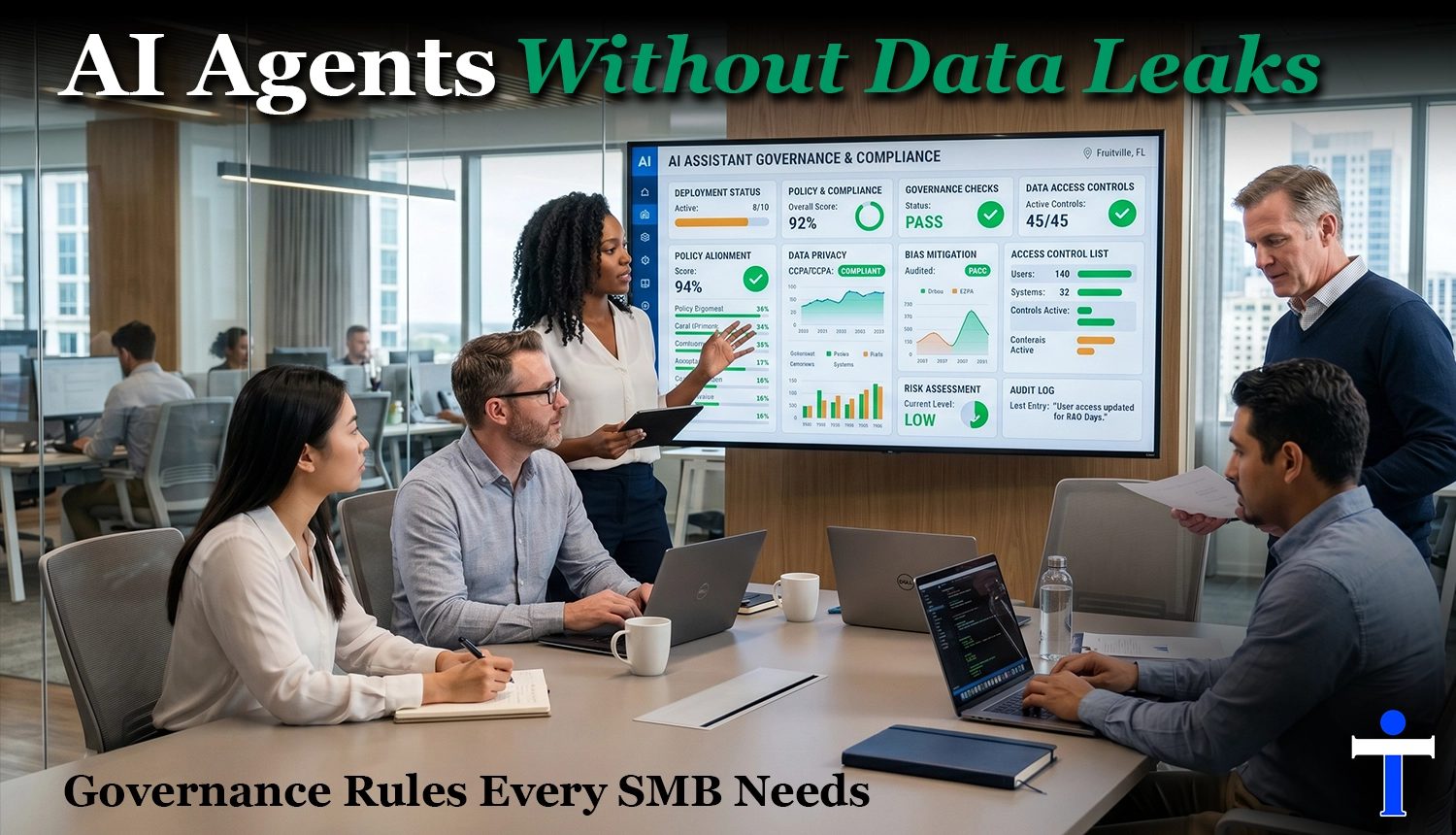
AI agents can save time, but they also multiply exposure if teams let them access everything by default. SMBs do not need heavyweight enterprise governance to get started. They need clear rules about what AI can see, what it can do, and when humans must review its output.
This guide turns governance into a practical operating model. You will get the five most common failure points, a lightweight policy stack, role-based access guidance, sample policy language blocks, and a monitoring cadence that fits real SMB teams.
The Top 5 AI Governance Gaps in Growing SMBs
Most governance problems begin with speed. A tool gets adopted for one workflow, then quietly expands into others without policy, access review, or logging. The result is shadow usage, data exposure, and inconsistent accountability.
- Gap 1: No approved list of AI tools, so teams sign up individually.
- Gap 2: Sensitive data is pasted into agents without classification rules.
- Gap 3: Human review is optional even for external or financial outputs.
- Gap 4: Admin accounts and shared credentials are used too broadly.
- Gap 5: Monitoring and review happen only after an issue is discovered.
A Lightweight Policy Stack You Can Implement This Month
Keep the policy stack short enough that employees can actually follow it. Four documents are usually enough to start: acceptable use, data handling, review and escalation, and access management.
- Acceptable use: which AI tools and use cases are approved.
- Data handling: which data types can and cannot be entered into an AI tool.
- Review and escalation: what requires human approval before release.
- Access management: who can create, configure, or administer AI tools.
Policy works when it is short, specific, and paired with real workflow examples.
Role-Based Access and Data Classification Essentials
Treat AI like any other business system with access tiers. Not every employee needs the same level of configuration power, and not every dataset should be available to every prompt.
- Public: approved for general drafting or idea generation.
- Internal: allowed only in managed tools with retention and admin visibility.
- Confidential: requires explicit approval before being used in AI tools.
- Restricted: never entered into public or unmanaged AI systems.
Do use: approved public marketing copy in a managed AI drafting tool with human review. Do not use: customer payment records, passwords, or private HR notes in a general-purpose AI chat.
Sample Policy Language Blocks
Acceptable use: Employees may use approved AI tools for drafting, summarization, and workflow assistance when the output is reviewed before external use.
Data handling: Confidential customer, financial, HR, and credential data must not be entered into any AI system unless the system is specifically approved for that data class.
Escalation: Any suspected exposure, hallucination, or policy violation involving AI must be reported to the designated owner within one business day.
Monitoring, Review Cadence, and Policy Evolution
Governance only works if it evolves with usage. Monthly check-ins are usually enough for SMBs at the start, with quarterly policy review as adoption matures.
- Track approved tools, active use cases, and owner assignments.
- Review any exceptions granted for new workflows or temporary access.
- Audit a small sample of prompts or outputs where policy allows.
- Update the training examples when a new risk pattern appears.
- Run a quarterly tabletop for AI leak, misuse, or output-quality failures.
AEO Quick Answers
What is the simplest AI governance policy for SMBs? Define approved tools, data classes, human review rules, and an escalation owner.
What data should never go into an AI agent? Passwords, payment data, private HR records, regulated data, and any information your policy marks as restricted.
How often should AI governance be reviewed? At least monthly at first, then quarterly once usage stabilizes and controls are working.
Bottom Line
AI governance is not about blocking adoption. It is about making adoption repeatable, measurable, and safe enough to scale. SMBs that define clear rules now will move faster later because their teams will not be guessing where the boundaries are. If you want help turning this into a working policy set, schedule a consultation at cravenit.solutions/consult and build your AI operating model with controls in place from day one.