
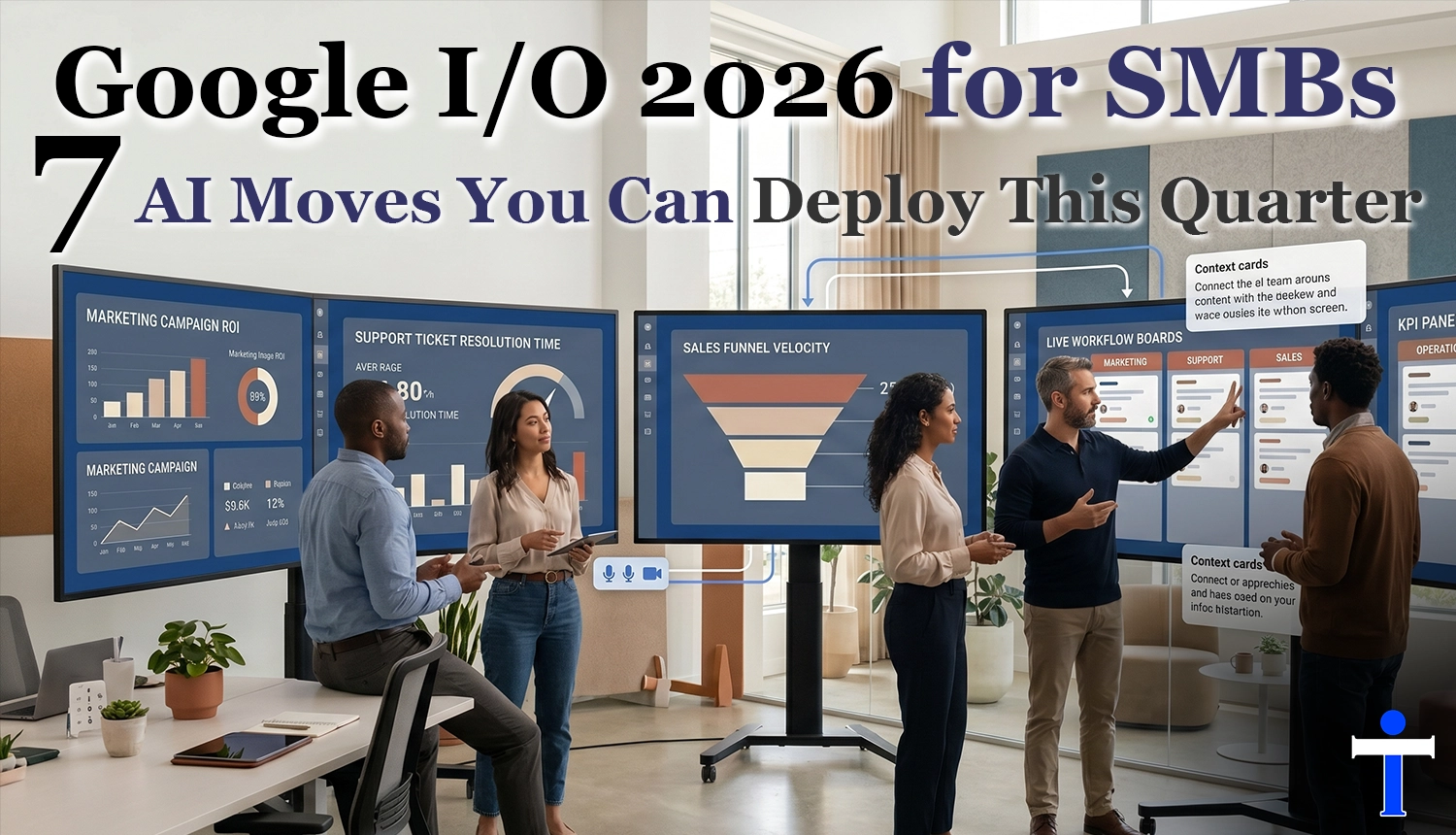
Most teams leave major AI announcements in slide decks. The gap is not awareness. The gap is execution sequence. SMB leaders do not need another recap of product demos. They need a concrete plan that maps capabilities to workflows, owner roles, and measurable outcomes.
This guide translates Google I/O 2026 momentum into seven deployable moves for small and midsize businesses. You will get practical examples across marketing, support, sales, and operations, plus cost and governance controls that keep AI adoption useful instead of chaotic.
What Actually Changed for SMB Operators
The important shift is convergence: model capability, workflow interfaces, and automation hooks are maturing together. That makes cross-functional deployment easier, but also increases the risk of fragmented adoption if teams launch tools without governance and success metrics.
- Assistant experiences are moving from chat answers to multi-step task execution.
- Multimodal inputs allow teams to combine text, image, video, and meeting context in one workflow.
- AI workspace integration reduces friction for non-technical teams.
- Automation APIs increasingly support action orchestration, not just content generation.
- Enterprise-grade controls are becoming more available to smaller teams through managed platforms.
The 7 Highest-Leverage AI Moves This Quarter
Do not launch all seven at once. Prioritize by business friction and measurable upside. Each move below should have an owner, a baseline metric, and a 30-day checkpoint.
- Move 1 - Customer support triage assistant: classify inbound requests, suggest response drafts, and route high-risk tickets to human review.
- Move 2 - Marketing content ops pipeline: automate briefs, variant testing assets, and campaign repurposing while preserving editorial approval.
- Move 3 - Sales enablement copilot: summarize calls, surface objections, and generate next-step plans tied to CRM stages.
- Move 4 - Internal knowledge retrieval: connect SOPs, service docs, and policy references into a searchable assistant with permission controls.
- Move 5 - Meeting-to-action automation: convert meetings into tasks, owners, deadlines, and follow-up sequences.
- Move 6 - Ops anomaly assistant: detect workflow bottlenecks, missed SLAs, and repeat failure patterns from operational telemetry.
- Move 7 - Executive KPI narrative layer: convert dashboards into plain-language weekly summaries with risk flags and recommended actions.
Adoption speed without workflow ownership creates AI noise. Ownership plus measurement creates AI advantage.
Function-by-Function Examples
- Sales: auto-generated account briefs before calls and next-step task generation after calls.
- Support: intent detection plus escalation prompts for sensitive requests.
- Marketing: creative variant generation paired with approval gates and performance feedback loops.
- Operations: recurring process exception detection and weekly remediation recommendations.
Cost, Risk, and Governance Guardrails
Guardrails prevent rework and reputation risk. Keep governance lightweight but explicit. If teams do not know what data is allowed, what output requires review, and who owns incidents, adoption quality will degrade fast.
- Define approved data classes for AI tools and block sensitive categories by default.
- Require human review for customer-facing or compliance-sensitive outputs.
- Track model and workflow usage costs by team to prevent spend drift.
- Log key prompts and outputs for quality review where policy allows.
- Set incident response paths for hallucination risk, data leakage, or automation errors.
A 90-Day AI Implementation Roadmap
Use a staged rollout so teams can prove value while controlling risk. This cadence is designed for SMB operating rhythm, not enterprise transformation timelines.
- Days 1-30: Select two pilot workflows, define baseline metrics, and finalize policy guardrails.
- Days 31-60: Launch pilot automations, run weekly quality reviews, and document exception handling.
- Days 61-90: Expand to adjacent teams, harden governance, and publish KPI delta summary for leadership.
AEO Quick Answers
What is the best first AI move for SMBs after Google I/O? Start with one customer-facing workflow and one internal productivity workflow so you balance revenue impact with execution efficiency.
How long should SMB AI pilots run? Run 30-day pilots with weekly reviews, then decide on scale based on measurable performance deltas.
Do SMBs need full AI governance before starting? No, but they need minimum viable guardrails immediately: data policy, human-review boundaries, and incident ownership.
Bottom Line
Google I/O cycles create opportunity windows, but only teams that execute with structure convert those windows into durable advantage. Pick high-friction workflows, deploy controlled pilots, and scale what proves value. If you want help building your custom 90-day rollout, schedule a strategy session at cravenit.solutions/consult and align AI execution to business outcomes.