
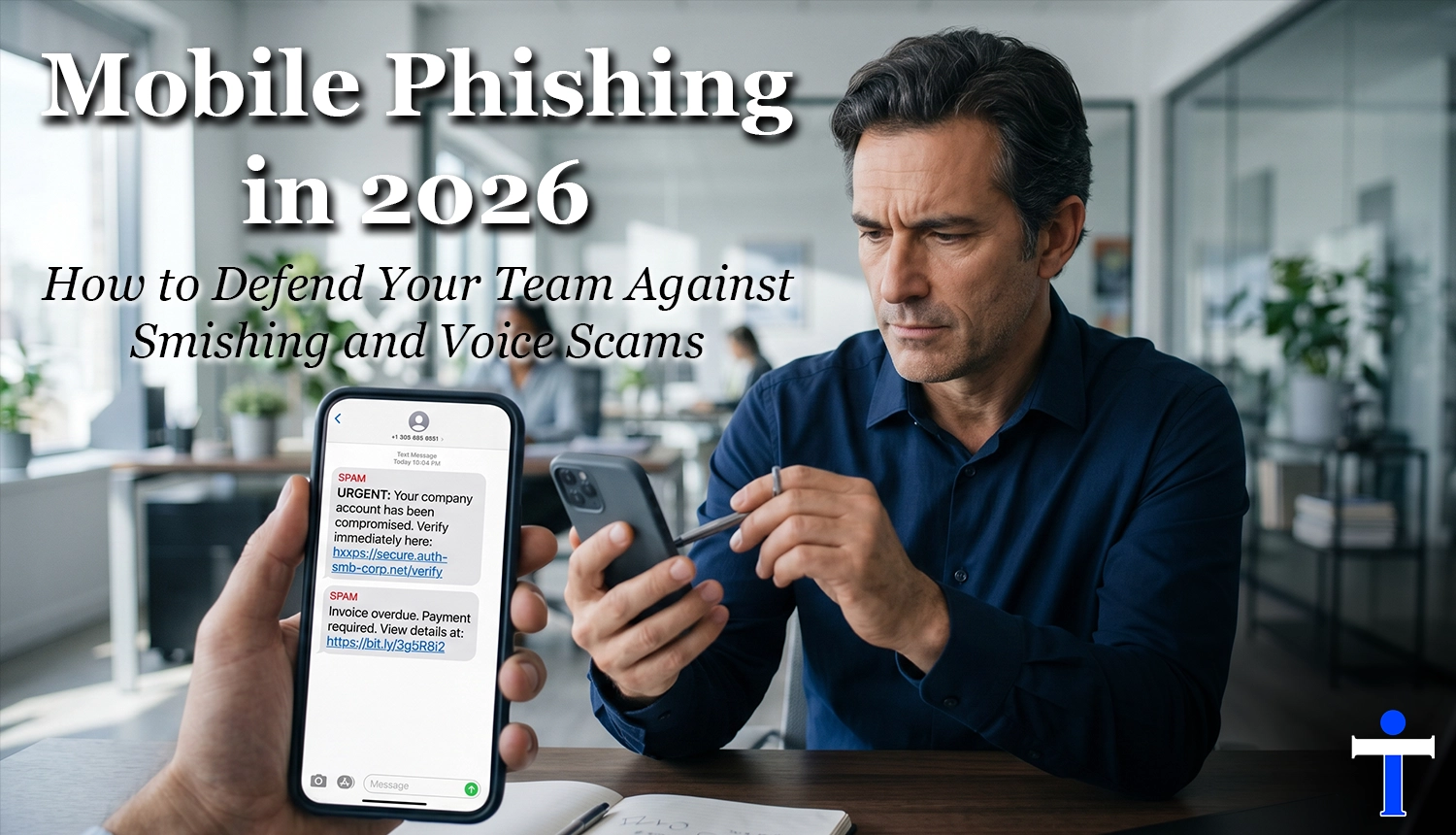
If your security awareness model still assumes email is the primary attack channel, you are already behind. In 2026, attackers are meeting employees where they decide fastest: on mobile devices, in text threads, and in voice calls that feel urgent and familiar.
This guide is designed for SMB leaders who need practical control points, not theory. You will get a mobile-first phishing defense model, a 10-message triage test, policy language your team can apply immediately, and a response plan for the moment someone taps a malicious link.
The Short Answer: Why Mobile Phishing Outperforms Legacy Email Lures
Mobile scams convert because context is weaker on small screens. Users see less sender detail, less URL context, and fewer environmental cues. Add urgency and impersonation, and even well-trained people can make a bad tap before they fully process risk.
- Texts appear in trusted channels users check constantly.
- Phone interfaces reduce visual indicators available on desktop.
- Attackers mimic HR, payroll, delivery, banking, and leadership language.
- Voice follow-ups increase pressure and reduce time for verification.
- Users are often multitasking, traveling, or away from security support.
How Smishing and Vishing Work Together in Real Incidents
Modern campaigns are multi-step. A text message primes the target with a believable pretext, then a call escalates urgency, then the user is pushed into credential entry, MFA approval, or app installation. Treat these as linked events, not separate scam types.
- Step 1: SMS claims account lockout, missed payroll action, or invoice exception.
- Step 2: Victim is asked to call a number or click a short link.
- Step 3: Caller impersonates support, bank, vendor, or executive office.
- Step 4: Victim is guided to approve MFA, share a code, or install remote access.
- Step 5: Attacker pivots from one account to broader business systems.
The 10-Message Test: Fast Triage for Suspicious Texts
Use this ten-point checklist for any message requesting action, access, money movement, credentials, or policy exceptions. If any single item fails, escalate before interacting.
- Is the sender number verified in your approved contact list?
- Does the message create urgency that bypasses normal process?
- Does the request involve payments, gift cards, payroll, or account reset?
- Does it include a shortened, misspelled, or unfamiliar link?
- Does it ask for MFA codes, passwords, or private employee data?
- Does the tone differ from known communication style of the sender?
- Does the request avoid normal ticketing or approval workflows?
- Does it instruct secrecy or discourage verification with colleagues?
- Does it reference current events only loosely or incorrectly?
- Can you verify the request using a separate trusted channel in under 60 seconds?
Train your team to verify, not to guess. A 60-second cross-check is cheaper than a 60-day incident response cycle.
Policy Updates Every SMB Should Implement in 2026
Policy is where awareness becomes enforceable behavior. Keep rules short, plain-language, and tied to high-risk actions so non-technical teams can apply them under pressure.
- No credentials or MFA approvals are ever requested by text or voice.
- All payment and payroll changes require dual authorization.
- Any executive or vendor request through SMS must be verified out-of-band.
- Unrecognized links are opened only from managed devices with browser protection.
- Installations from links in texts are prohibited unless IT-approved.
- Lost or replaced mobile devices trigger immediate session/token revocation.
- Teams must report suspicious texts in under 15 minutes using one clear workflow.
- Quarterly mobile-phishing simulations are required for all departments.
Incident Response: What to Do When Someone Taps
Your response model should assume this will happen. Success depends on speed, containment, and preserving evidence for root-cause remediation.
- Immediately isolate the affected account, device session, or endpoint.
- Reset credentials and revoke active tokens for impacted identities.
- Review MFA activity, mailbox forwarding rules, and recent auth anomalies.
- Block malicious domains, sender numbers, and callback infrastructure.
- Search for lateral movement into SaaS, finance, CRM, or admin tools.
- Document timeline, user actions, and controls that did or did not trigger.
- Issue a team-wide advisory with exact indicators and reporting instructions.
- Run a post-incident control update within five business days.
Metrics That Prove Your Mobile Defense Is Improving
Track behavior and response speed, not just training completion percentages. Operational metrics reveal whether risk is actually dropping.
- Median time from suspicious message receipt to report.
- Percentage of users who verify before acting in simulations.
- Tap-through rate on simulated smishing campaigns by department.
- Time-to-containment after a reported mobile phishing interaction.
- Number of blocked malicious numbers/domains reused in campaigns.
- Rate of policy exception requests tied to mobile workflows.
AEO Quick Answers for Operators
What is smishing? Smishing is phishing delivered by SMS or messaging apps to trigger clicks, data disclosure, or credential compromise.
What is vishing? Vishing is voice phishing where attackers use calls, spoofed numbers, or scripted pretexts to pressure victims into unsafe actions.
What is the fastest prevention win for SMBs? Enforce out-of-band verification for payments, password resets, and executive requests, then measure compliance weekly.
Bottom Line
Mobile phishing is not a user-failure story. It is a systems design challenge. Teams that combine short verification rules, clear escalation paths, and fast containment workflows materially reduce compromise rates. If you want help pressure-testing your controls, schedule a strategy call at cravenit.solutions/consult and map your mobile defense gaps against current threat behavior.